
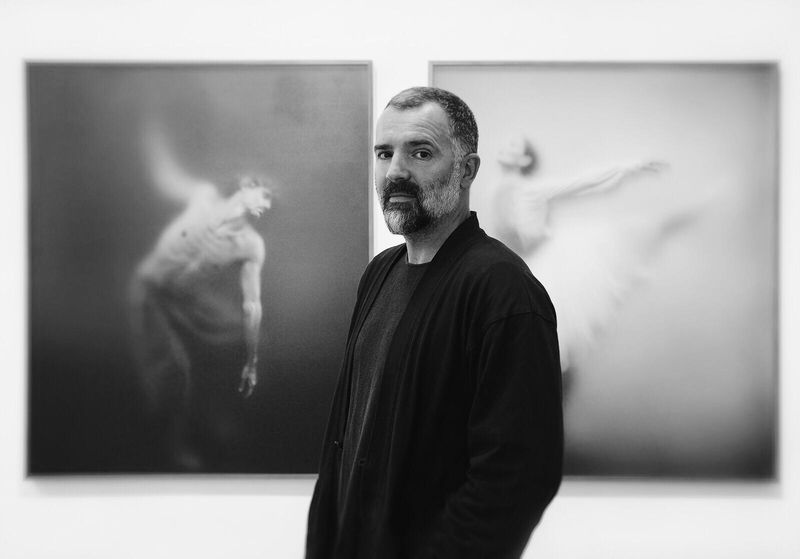
Looking at Casper Faassen's work is like looking through the mist of time.
Casper Faassen (b. 1975) is a Dutch artist based in Leiden. Raised in a city shaped by the legacy of the Dutch Masters, Faassen found inspiration in their attention to light and atmosphere, qualities that continue to inform his practice, which merges photography and painting. He transforms photographs into layered works characterised by translucent surfaces and his signature craquelure, creating a distinctive visual language. His work is held in both private and public collections, including Museum de Lakenhal (Leiden), Frans Hals Museum (Haarlem), the Royal Library (The Hague), the J.P. Morgan Collection (USA), and the Møller Collection (Oslo).
A recurring theme in Faassen's work is that which remains hidden. His compositions use absence, obscurity and negative space as active elements of the image, giving what remains unseen as much significance as what is revealed. Through carefully constructed compositions, layered surfaces and subtle veiling, Faassen creates images that seem to hold them just beyond reach.
This approach runs through Faassen's diverse bodies of work. His landscapes draw on the Japanese concept of Ma, where empty space holds as much meaning as form. His longstanding Movement series examines similar questions through collaborations with dancers, focusing on the relationship between stillness and motion, presence and disappearance. His most recent works were created in collaboration with Ayaha Tsunaki, Principal Dancer of Ballett Zürich.
In ReCollection, another continually evolving artistic pursuit, Faassen reimagines cultural artefacts with layered - and often contested - histories. Through a process he calls ReCollecting, he traces dispersed cultural belongings and transforms them into poetic reflections on memory, ownership and cultural responsibility. Recent presentations include an installation at Pera Museum, Istanbul, where works from the series entered into dialogue with Yeni Camii and The Port of Istanbul (1776) from the museum's collection, inviting reflection on cultural displacement, restitution and the layered histories carried by objects.